Banner
Mental Health and Wellness month
Needoh

Social Media Trends and the Popularity of NeeDoh Toys

A squishy, colorful toy is both a social media trend and a therapeutic tool.


Key points

  • Being aware of social media trends is necessary when working with individuals of all ages.
  • Social media can have positive and negative influence, particularly on teen girls.
  • Stress toys can help replace problematic behaviors.

As a clinical psychologist and avid cultural observer of trends, I am fascinated by the recent uptick in interest in NeeDoh toys. These squishy toys (shaped like balls or cubes) come in a variety of shapes and colors and can be stretched and squeezed and used as toys and/or stress balls. Toy stores can't keep them in stock for longer than 30 minutes once word gets out that there has been a recent shipment. Lines form outside of stores in pursuit of the NeeDohs.

So what is at play here? Why are these toys so popular? What purpose are they serving? There are several factors that have created this trend. Of course, social media is involved. These balls and cubes in their bright neon colors are all over TikTok. We are all aware of the power of social media, particularly among teen girls, who especially love these toys. Second, the hunt for these items is exciting. Who doesn't enjoy a fun treasure hunt? If they were readily available, the thrill of the chase would be gone, and "the hunt" is part of the fun. Third, they lend themselves to being collectibles since they come in different sizes, shapes, colors, and textures. Finally, they work as excellent stress balls, and the teens in my practice who engage in self-harm and skin picking find them to be an effective alternative to problematic behaviors. They certainly don't eliminate the urge to cut or pick at the skin, but they provide an alternative that is safe and fun.

I must admit that I, too, have traveled around in pursuit of these NeeDohs and have formed a collection. I am lucky enough to have a dear psychologist friend who found the NeeDohs in a store on the main street of her town and actually sent me some by overnight mail. We had a lot of fun engaging in this pursuit as a team. Also, keep in mind that most stores will limit you to purchasing two per family, so friends can be very helpful if you are using them as part of your therapeutic work and want to make them available to your patients.

I have learned that adults also like these toys and use them to reduce stress and anxiety. They can be used as alternatives to nail biting, hair twirling, and other behaviors that we engage in while working or studying. In psychology, we refer to these behaviors as adjunctive behaviors, which are behaviors that we engage in while working, studying, or even writing our Psychology Today posts, as a way to stay relaxed and focused. Adults, teens, and children who struggle with attentional issues and focus find these toys helpful in maintaining focus. In fact, I learned that a number of teachers have taken their breaks early to get in line to purchase these items for their students. I have been speaking with store owners to learn about consumer behavior and trends.

I want to be clear that I do not work for the company that manufactures NeeDohs. I am, however, always in active pursuit of therapeutic tools to help my patients. I also find it necessary to be aware of social media trends that influence both self-destructive and prosocial behavior. My teens, in particular, are influenced by TikTok and Instagram. Finally, one teen said it best when she said that stress toys help her when she is about to "crash out" (have a meltdown).


https://www.psychologytoday.com/us/blog/the-teen-doctor/202604/social-media-trends-and-the-popularity-of-needoh-toys

Written by: Barbara Greenberg, Ph.D., Updated April 19, 2026 |  Reviewed by Margaret Foley. Accessed 4/21/2026.

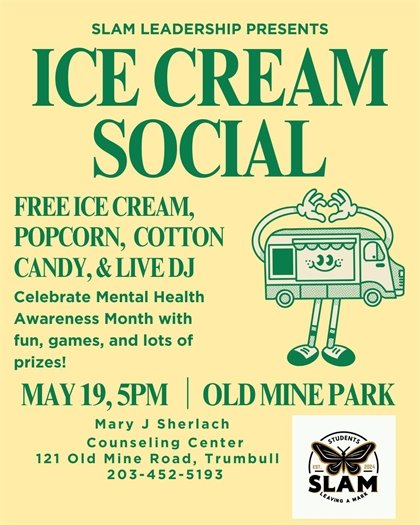
Ice Cream Social

Join us for our 3rd annual Ice Cream Social!! Come have fun and ice cream with the family. Games and prizes and fun for everyone. 

play

What Neuroscience Tells Us About Play and Stress Relief


For young children, play isn’t just joyful, it’s essential. Early educators have long known this intuitively, and now neuroscience gives us language to explain why. Play is one of the brain’s most powerful tools for buffering stress, building resilience, and supporting healthy development.

In a world where even preschoolers are experiencing higher levels of stress — from unpredictable routines, overstimulation, or environmental instability — understanding play’s protective power is more important than ever.

How Stress Affects the Young Brain
 When children face stress, their bodies release cortisol, the “stress hormone.” Short bursts of cortisol can be adaptive, but prolonged stress can interfere with brain development, especially in the areas responsible for learning, memory, and self-regulation. The good news? The developing brain is also highly responsive to protective factors, and play is one of the strongest.

Play as a Natural Stress Buffer
 Unstructured, child-led play activates neural pathways associated with curiosity, exploration, and joy. This lowers cortisol levels and engages the brain’s reward systems. Over time, these repeated experiences help children learn to regulate emotions, adapt to change, and build trust in themselves and others.

Social Play Builds Resilience
 Play isn’t just an individual activity, it’s also social. When children negotiate turn-taking, invent stories, or work through conflicts during play, they’re developing critical stress-coping skills. These peer interactions strengthen neural circuits tied to problem solving, emotional regulation, and empathy.

The Educator’s Role: Making Space for Play
 When educators protect time for open-ended, joyful play, they’re doing more than supporting learning goals — they’re supporting emotional health and well-being. Simple choices like allowing longer blocks of uninterrupted play or creating calm, inviting play spaces can help children feel safe and secure.

Play Is Protective
 Research has shown that children who experience consistent opportunities for joyful, supported play are better able to handle stress and recover from challenges. In this way, play acts like an emotional “buffer,” helping children build the resilience that will carry them into kindergarten and beyond.

Play is far more than a break from learning — it’s a biological safeguard, equipping children with the emotional strength and stress-buffering skills they need to thrive. By making time for play and protecting its place in early childhood classrooms, educators are supporting the healthy development of the whole child.

https://earlylearning.highlights.com/blogs/the-confident-classroom/what-neuroscience-tells-us-about-play-and-stress-relief?srsltid=AfmBOooRFvVXYGFHzsljRl4-pyjM3Ke6leMc_XVIYl4M1CEUqvLFe2Of

Written by; Laureen Reynolds, Highlights Early Learning's Director of Product and a former preschool teacher. Dec 06, 2025. Accessed on 4/22/2026

May events


May 6, 2026

Elementary school tutoring 5:30 – 6:30 pm. Trumbull Public Library 33 Quality Street (registration required) 

Middle school tutoring 6:30 – 7:30 pm. Trumbull Public Library 33 Quality Street (registration required)


May 7, 2026

High school tutoring 5:30 – 6:30 pm. Trumbull Public Library 33 Quality Street (registration required) 

Middle school tutoring 6:30 – 7:30 pm. Trumbull Public Library 33 Quality Street (registration required)


May 12, 2026

Grief and Loss Support Group, 9:00 AM. 23 Priscilla Place. 


May 13, 2026

Elementary school tutoring 5:30 – 6:30pm. 121 Trumbull Public Library 33 Quality Street (registration required) 

Middle school tutoring 6:30 – 7:30pm Trumbull Public Library 33 Quality Street (registration required)


May 14, 2026

High school tutoring 5:30 – 6:30pm Trumbull Public Library 33 Quality Street (registration required) 

Middle school tutoring 6:30 – 7:30 pm. Trumbull Public Library 33 Quality Street (registration required)


May 19, 2026

Ice Cream Social MJSCC & SLAM community event 5:00 pm – 7:00 pm Old Mine Park 121 Old Mine Road. 


May 20, 2026

Elementary school tutoring 5:30 – 6:30pm. 121 Trumbull Public Library 33 Quality Street (registration required) 

Middle school tutoring 6:30 – 7:30pm Trumbull Public Library 33 Quality Street (registration required)


May 21, 2026

High school tutoring 5:30 – 6:30pm Trumbull Public Library 33 Quality Street (registration required) 

Middle school tutoring 6:30 – 7:30 pm. Trumbull Public Library 33 Quality Street (registration required)


May 25, 2026

Mary J. Sherlach Center Closed – Memorial day. 


May 26, 2026

Grief and Loss Support Group, 9:00 AM. 23 Priscilla Place. 


May 27, 2026

Elementary school tutoring 5:30 – 6:30pm. 121 Trumbull Public Library 33 Quality Street (registration required) 

Middle school tutoring 6:30 – 7:30pm Trumbull Public Library 33 Quality Street (registration required)


May 28, 2026

High school tutoring 5:30 – 6:30pm Trumbull Public Library 33 Quality Street (registration required) 

Middle school tutoring 6:30 – 7:30 pm. Trumbull Public Library 33 Quality Street (registration required)

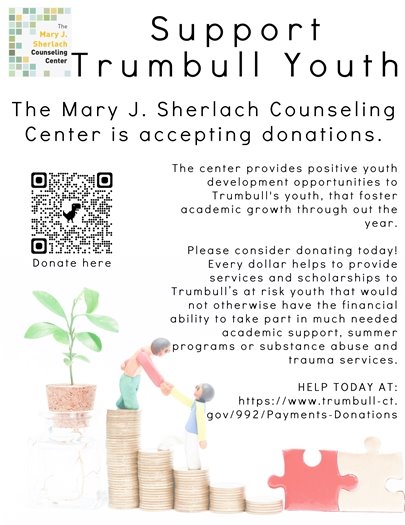
Donation
connect with us
Share on Facebook
Share on Twitter
Share via Email

Copyright 2024 Town of Trumbull. All Rights Reserved.
5866 Main Street, Trumbull, CT 06611

Powered by
CivicSend - A product of CivicPlus